
Polyester Strapping FAQ
Answers to common questions about polyester (PET) and PP strapping: why strap, differences, sizes and buckles, application, export terms, quality, delivery and pricing.
Why Strapping(8)
Why should I use strapping to package my products?
Strapping holds a package or pallet together as one unit through shipping and storage; you can start by hand and move up to battery tools and machines as volume grows. Polyester (PET) and PP strapping do not rust, so they leave no rust marks on the load in a damp warehouse or an open yard. Where there is no power or compressed air, the strap still goes on by hand with buckles. The Industries pages show which strap fits steel, lumber, brick, marble and corrugated board.
What do I need to start strapping my packages?
To start by hand you need a coil of strap, strapping buckles and a manual tool (a tensioner and a buckle tool); no electricity or compressed air is required. For a few pallets that kit is enough; as volume grows you move to a battery or pneumatic tool, or to a semi-automatic machine for cartons at a workstation. We supply strapping tools and machines and offer strapping buckles and dispenser carts. Choose strap width and thickness by the weight of the load; if you are unsure, send us the load weight and size.
Which industries strap their products?
These loads are strapped: steel coils and bundles, lumber and wood panels, brick and block, marble and stone, glass, ceramics, paper, corrugated board, plastic pipe and automotive parts. Our site has a separate page for each of 22 industries, with the recommended strap size, break strength and application method. We recommend PET strap for heavy loads such as steel coils, marble slabs and heavy brick cubes, and PP strap for lighter loads such as corrugated board, paper and plastic pipe. If your industry is not listed, send us the load weight and size.
Do I need strapping on a pallet that is already stretch-wrapped?
On pallets that go into containers or change hands several times, yes: use stretch film and strapping together. The film holds the cartons together, while the strap ties the pallet to its base against handling forces. Cartons on a mixed pallet differ in size and weight, and although the film holds the surface, the top layers can shift under forklift and container shocks, and the more often a pallet changes hands, the more that matters. On bag pallets, strap also limits slippage of the top layers and works well together with stretch film.
Should I strap by hand or with a machine?
Choose by how many straps you apply per day and where you work: by hand for a few straps, with a machine for heavy volume. Banding by hand with buckles is enough for a few pallets. A battery tool suits work in the field and a pneumatic tool suits a plant with a compressed-air line; a semi-automatic machine at a packing table and an automatic machine at the end of the line speed the work up. Whichever you choose, buy strap that fits the width and thickness range your tool or machine accepts.
How should I compare the cost of strapping?
Compare the total cost of banding a pallet or a coil, not the price per kilogram. Count the cost per meter of strap, the buckle, the tool, the labor and the freight. Steel strapping can look cheaper per kilogram, but it is much heavier: each kilogram yields fewer meters of strap, and you ship more weight. If you are unsure, run a trial banding with sample strap.
Which loads still need steel strapping instead of PET?
Hot-rolled material that has not cooled and loads with very sharp edges may still call for steel strapping. Heat takes the tension out of polymer strap, so band the product after it cools. On very heavy, multi-pallet loads, keep steel in the comparison: measure the load and the transit conditions first, then compare the break strength you need with your current steel strap. On cold material with edge protection, test PET in a trial shipment.
What should I ask my strap supplier about raw material if I ship to the EU?
Ask your supplier for the strap's raw-material declaration and the documents behind it when you request a quote. The EU Packaging and Packaging Waste Regulation (PPWR) has applied since August 12, 2026 and covers all packaging regardless of material. For other plastic packaging such as PET strapping, it sets a minimum post-consumer recycled content of 35% from 2030 at the earliest and 65% from 2040. Our PET strapping feedstock is 100% PET flake, meaning bottle flake from collected PET bottles; the rate and date that apply to your product are reviewed together at quotation.
Products(10)
What is PET (polyester) strapping?
PET strapping, also called polyester strapping, is high-strength plastic strapping made from polyethylene terephthalate that secures loads to pallets, bales or bundles. It does not rust and weighs less than steel, so it is the common alternative to steel strapping for medium and heavy loads. Polipak's polyester strapping comes in widths from 3/8 in to 3/4 in (9–19 mm), with break strengths from 375 lbf to 2,150 lbf (170–975 kg).
Polyester vs polypropylene strapping: which should I use?
Use polyester (PET) strapping for medium and heavy loads and long transits; use polypropylene (PP) strapping, the more economical option, for light and medium loads such as cartons. PET strapping is made from polyester, breaks at 375–2,150 lbf (170–975 kg) and serves as a steel strapping alternative. PP strapping is made from virgin polypropylene, breaks at 187–595 lbf (85–270 kg) and stretches more than PET.
What is the difference between embossed and smooth polyester strapping?
Embossed polyester strapping has a raised pattern on its surface; smooth polyester strapping has a flat surface. The pattern reduces slippage in buckles and tool grippers, while a smooth surface suits marking, printing and some special machines. At the same size, smooth strap has the higher break strength: at 3/4 in × 0.050 in (19 × 1.27 mm), embossed breaks at 1,929 lbf (875 kg) and smooth at 2,150 lbf (975 kg).
Can polyester strapping replace steel strapping?
Yes. For most medium and heavy loads, polyester (PET) strapping replaces steel strapping. It does not rust, weighs far less than steel, has no sharp edges, which makes it safer to handle, and holds its tension as the load settles. For very heavy, multi-pallet loads, choose a PET size that matches the break strength of your current steel strap.
What is Superbant?
Superbant is a patented embossed strapping developed by Polipak Plastik and registered in Türkiye. It is fully compatible with battery-powered and buckle-type strapping tools and comes in 1/2 in and 5/8 in (12 and 16 mm) widths. Standard colors are white, black, red, yellow and green; other colors are made on request.
Is your polyester strapping really made from 100% PET flake?
Yes. Our polyester strapping feedstock is 100% PET flake, meaning bottle flake from collected PET bottles. We do not use virgin PET.
What color options do you offer?
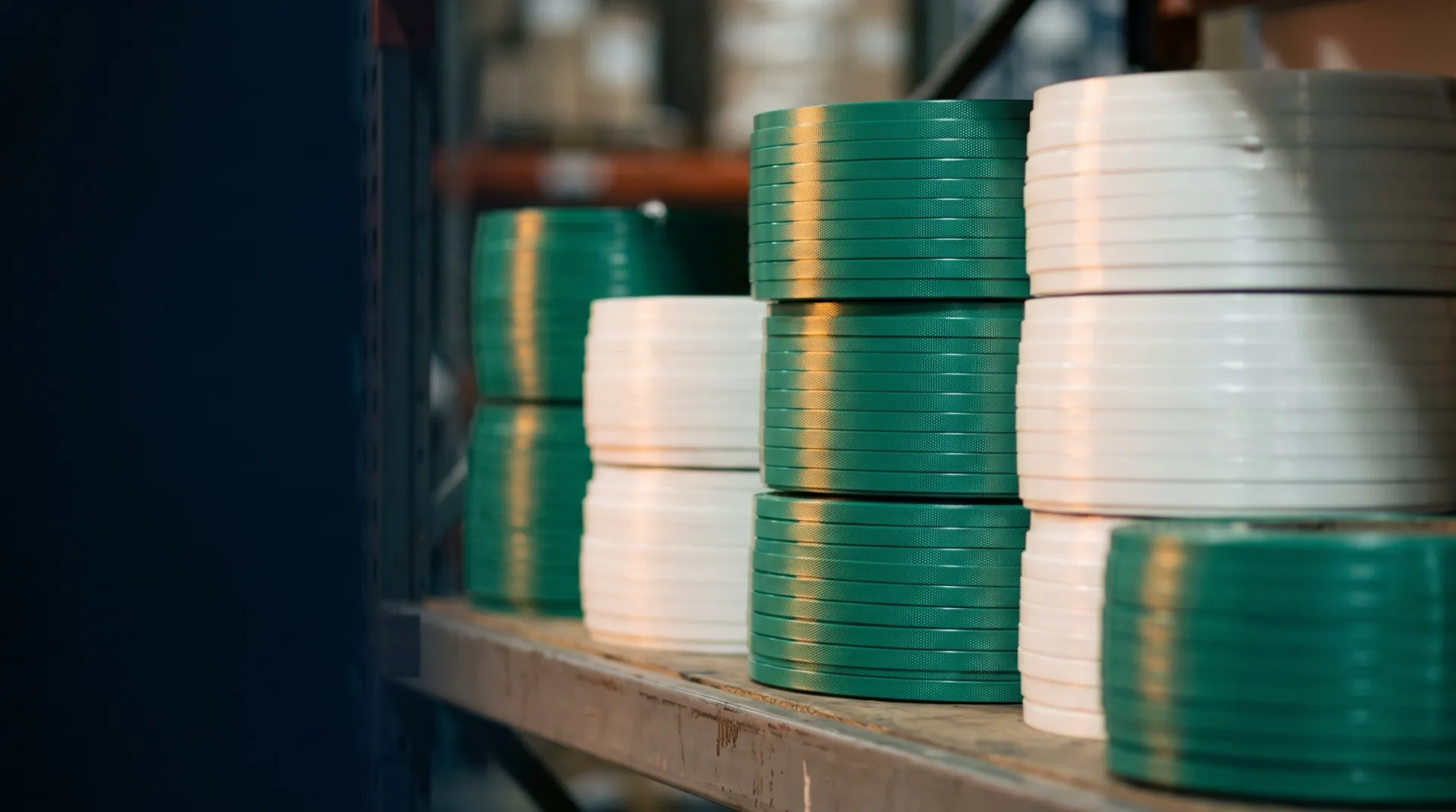
Green is the standard color for polyester strapping; black and clear are also available. PP strapping comes in white, yellow, green, blue and black, and Superbant in white, black, red, yellow and green. For a custom color, you can request a pilot run.
Can you produce custom widths or thicknesses?
Yes. Beyond our standard sizes, we run pilot production for custom sizes with a 1-ton minimum order quantity (MOQ). Contact our R&D team.
How do I choose a strapping tool?
Choose a strapping tool by strap type (polyester or polypropylene) and strap width first, then by how many straps you apply per day and where you work. For low volumes, a manual tensioner and buckle tool is enough. Battery strapping tools handle high volumes and work away from a fixed station, pneumatic strapping tools make sense in plants with a compressed-air line, and semi-automatic strapping machines are built for cartons at a workstation. The tool's width and thickness range must cover the strap you use.
What size strapping buckles do I need?
Match the buckle to the strap width: 5/8 in (16 mm) strap takes a 5/8 in buckle and 3/4 in (19 mm) strap a 3/4 in buckle, while 1/2 in (12–13 mm) buckles fit 1/2 in strap. The buckle's thickness range must also cover the strap thickness; on heavy loads, check buckle strength together with the strap's break strength.
Application(9)
How do I choose strap width and thickness?
Choose by the weight of the load and how far it travels: start with 1/2 in (12 mm) for light packs and 5/8 or 3/4 in (16 or 19 mm) for heavy loads. In PET strapping with the same surface, break strength rises with width and thickness: embossed polyester strapping breaks at 584 lbf (265 kg) at 1/2 in × 0.024 in (12 × 0.60 mm) and at 1,929 lbf (875 kg) at 3/4 in × 0.050 in (19 × 1.27 mm). The width must also fit your buckle and tool; confirm the choice with a trial shipment on your own load.
Which strap fits the strapping machine I already have?
Match the strap to your machine's type and to the width and thickness range it accepts. Polyester (PET) strapping runs on automatic machines, battery and pneumatic tools, and buckles. Virgin PP strapping runs on automatic and semi-automatic machines and by hand, and second-grade (recycled) PP runs on semi-automatic machines and by hand. Superbant is applied with battery tools and buckles. Tell us the make and model of your machine, and we will recommend a size to match.
How are the two ends of the strap joined: buckle or friction weld?
Both are used: a buckle joins the two ends of the strap mechanically, while friction welding melts the ends together at high speed without a buckle. Buckles go on by hand or with a manual buckle tool; friction welding is the standard joining method on battery-powered and automatic strapping machines, and it is cleaner and faster than a buckle. PP strapping is heat-sealed on semi-automatic table machines and automatic lines. The joint often carries less load than the strap itself, so on heavy loads look at the joint strength together with the strap's break strength.
How tight should the strap be?
Tight enough to hold the pack, not so tight that it stresses the load: start at that level. Test the setting on the first load and check it on arrival; if the load still shifts, add a band rather than raising tension. On fragile or crushable loads keep tension low, because an over-tensioned strap damages a glass-faced panel, crushes corrugated board and can ovalize a thin-walled pipe.
How many straps should go on a package or pallet?
The number of bands depends on the shape and length of the load; if the load shifts, add a band rather than raising tension. Space bands evenly: along the length of a pipe bundle, around the circumference of a cable coil, and both horizontally and vertically on a brick or block cube. On a heavy, irregular part, several bands spread the force more evenly than one heavy band.
Do I need corner protectors under the strap?
Yes, on loads with sharp edges or fragile or crushable surfaces. A tensioned strap cuts a sharp edge, bites into the corner of softwood, and on glass it concentrates tension on a small area; an edge or corner protector spreads the strap force along the edge. Use protectors on sheet and shapes, marble slabs, flat glass, printed sheet and paper pallets, and run the strap over the protector.
Which strap suits frozen storage and hot product?
In frozen storage use embossed PET strapping; in chilled storage above freezing, PP is enough for crate pallets. PP stiffens as it gets colder and loses impact strength; for frozen product an example size is 1/2 in × 0.028 in (12 × 0.70 mm) embossed PET at 661 lbf (300 kg). Heat also takes tension out of strap: do not apply PET to hot-rolled steel that has not cooled, and band the product after it cools.
What happens to strap tension when a strapped load sits in storage or outdoors?
The tension a strap holds drops slowly while a load waits, and PP loses tension faster than PET; for loads that will sit a long time or travel to a distant market, move to PET. Wood shrinks as it loses moisture and the strap loosens, so check tension before shipping after a long wait. On loads that will sit outdoors for months, sunlight wears down both polymers, PP faster, and UV-stabilized strapping is needed; say in your quote request that the load will wait in the open.
Is strapping enough to tie a load down to a truck or rail car?
No. Strapping holds the package together; tying a load down to a truck bed or rail car is a separate job for chains, binders or ratchet straps. The same split applies to machinery shipments: secure the machine to its skid with bolts or suitable fasteners, and let the strap keep the crate lid and panels closed, fix cases to the pallet and stop the crate from opening on an ocean voyage.
Export(4)
Which countries do you export to?
We have exported to 43 countries so far. The Russia & CIS section includes 5 countries, including Georgia. See our Export page for details.
How can I access certification documents?
We publish each document on the Certifications page once verification is complete. For a copy or the current status, use the contact form.
Which Incoterms do you work with?
We work with all of EXW, FCA, FOB, CIF, DAP, and DDP delivery terms. Which one fits depends on your market, order volume and preference.
What is your minimum order quantity?
MOQ is 1 ton for standard products and 1–5 tons for custom-size production. For volumes above 100 tons per year, a volume bonus applies under an annual frame agreement.
Quality(2)
What is the current status of quality and compliance documents?
Our current documents are the EN ISO 9001:2015 and EN ISO 14001:2015 certificates and two AAR verification documents for PET strapping; numbers, scope and dates are on the Certifications page. AAR approval covers only the products and sizes named on each document, and verification of other documents is in progress.
How does your quality control process work?
We test the raw material before production and the strap after it. Pre-process checks cover IV (intrinsic viscosity), moisture, and foreign material; product testing covers break strength, elongation, and bending-seam joint testing. Every lot comes with a COA (Certificate of Analysis).
Delivery(2)
What is your lead time?
Lead time is 2–4 weeks for standard products and 4–6 weeks for custom-size production. For export, add 10–45 days of ocean transit, depending on the destination.
Do you send samples?
Yes. We send 1–2 coils of free samples to B2B customers with serious interest. Shipping charges may apply depending on the region.
Pricing(2)
Do you have a price list?
We do not publish a price list on the site; our prices are updated weekly based on the ICIS raw material index. Fill out the Request a Quote form, and we will send you a price for your spec within 24 hours.
Do you offer annual contracts?
Yes. We sign annual frame agreements with customers buying more than 100 tons per year. They include a volume bonus, a fixed delivery schedule, and a price revision mechanism tied to a raw material index formula.
Didn't find your answer here? Reach out and get a response within 24 hours.
Contact Form