
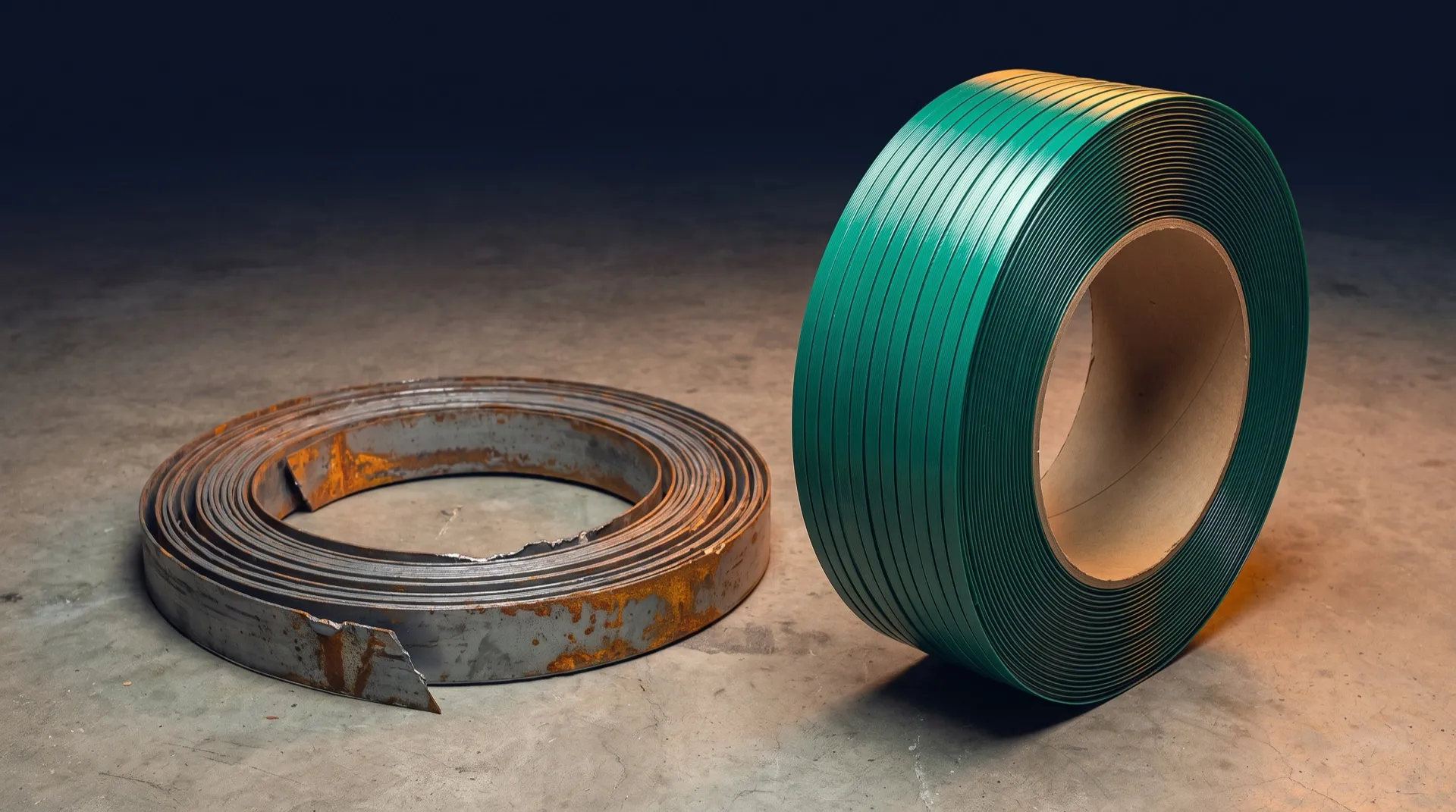
For most medium and heavy loads, polyester (PET) strapping can replace steel strapping. It does not rust, it weighs far less and it has no sharp edges. Load weight, edge profile and transit time decide the choice; for very heavy, multi-pallet loads, keep steel strapping in the running.
Polyester strapping and steel strapping under load
Polyester (PET) strapping has a high break strength: at 3/4 in × 0.050 in (19 × 1.27 mm), embossed polyester strapping breaks at 1,929 lbf (875 kg) and smooth polyester strapping at 2,150 lbf (975 kg). The bigger difference shows up over time. Steel strapping can loosen as a load settles, and it rusts in humid conditions; polyester strapping holds its tension through humidity and temperature swings. Polipak makes its polyester strapping from 100% PET flake, recovered from collected PET bottles.
When you switch from steel, the rule is simple: choose the PET size that matches the break strength of the steel strap you use today, and check the value in the product table.
How should you compare cost?
Compare the total cost of strapping one pallet or one coil, not the price per pound. Steel strapping can look cheaper per pound. But steel is much heavier, so each pound gives you fewer feet of strap, and you ship more weight.
Include cost per foot of strap, seals or buckles, tools, labor and freight. In medium and heavy-duty packaging, that math usually favors polyester strapping.
Safer handling with polyester strapping
Steel strapping has sharp edges, and cutting or removing it puts operators at risk of injury. Polyester strapping is flexible with smooth edges, so it is safer for hands-on work.
When is steel strapping still the right call?
If the load is very heavy and spans several pallets, take your time. Measure the load and the transit conditions before you drop steel, and compare the break strength you need with your current steel strap. If you are not sure, run a trial with sample coils.
Sizes, break strengths and colors are listed on our polyester strapping page.