
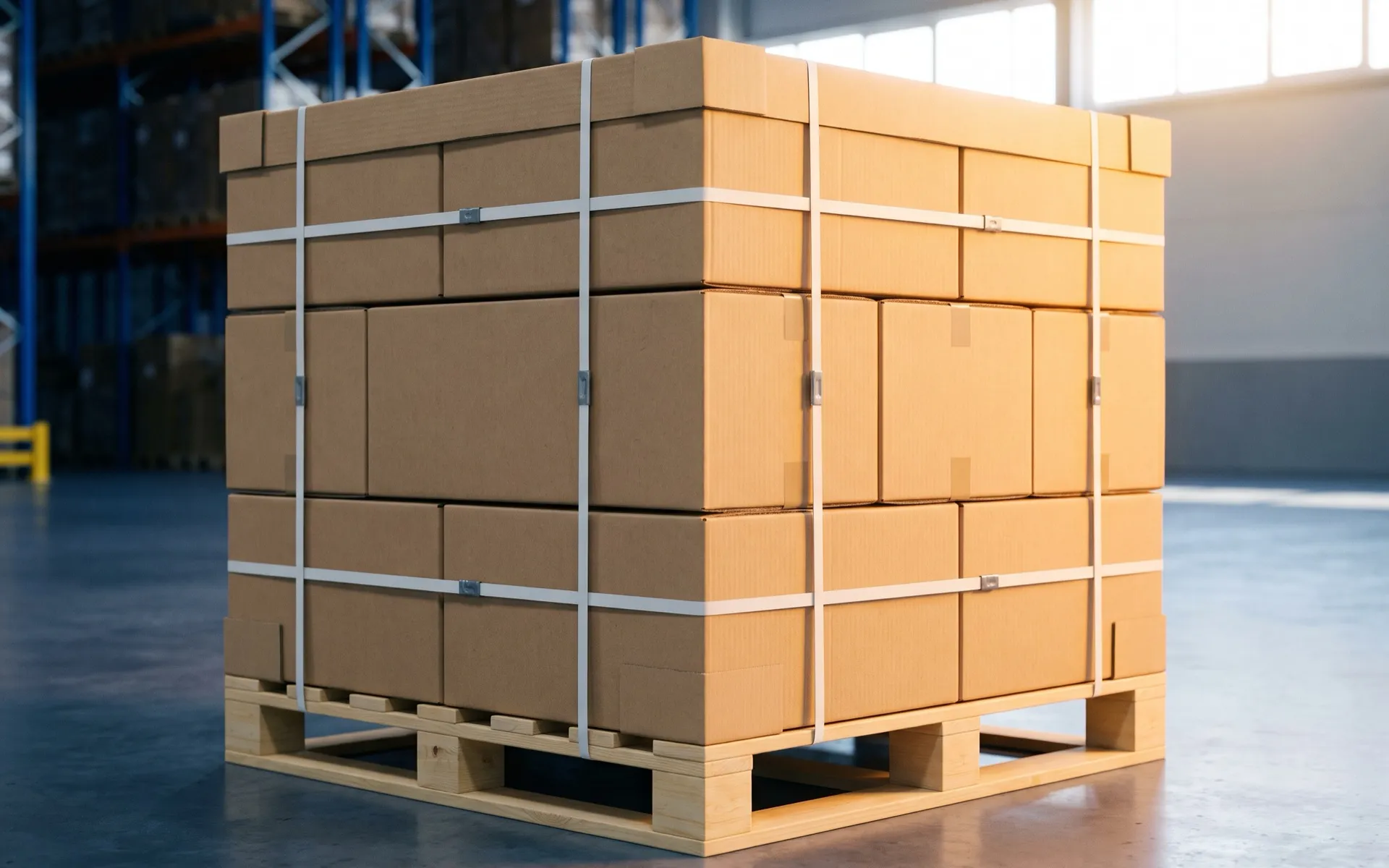
Use polyester (PET) strapping for heavy loads, long transit and long storage, and polypropylene (PP) strapping for light to medium cartons and bundles. The real difference is not break strength alone but how the two polymers behave at room temperature.
Same size, different break strength
Two examples from our catalog: 1/2 in (12 mm) × 0.024 in (0.60 mm) PP strapping breaks at 441 lbf (200 kg). The same size in embossed polyester breaks at 584 lbf (265 kg), and in smooth polyester at 672 lbf (305 kg). At 5/8 in (16 mm) × 0.031 in (0.80 mm) the gap widens: virgin PP 595 lbf (270 kg), embossed PET 1,025 lbf (465 kg), smooth PET 1,257 lbf (570 kg).
Those numbers matter, but they don't make the decision on their own. Break strength tells you where a strap fails in one fast pull. In the field a strap rarely breaks; it loosens. While a pallet sits in a warehouse or a container, the tension the strap holds drops little by little. That is where the two materials part ways.
Glass transition: the line between the two
Every polymer has a glass transition temperature. Below it, the disordered regions of the chains are locked in place; above it, the chains can slowly slide under load. For PET that point is roughly 158–176 °F (70–80 °C). For PP it is below freezing, usually given as about 14 °F (−10 °C).
In a 68 °F (20 °C) warehouse, PET works far below its transition. The chains stay put and the strap holds its tension. PP in the same warehouse sits above its transition: under load the chains shift over time, the strap stretches and tension falls. That is creep, and the loss of held tension over time is stress relaxation. On a carton pallet that ships in a few days you won't notice it. On a load that waits for months, or a bale rolling at sea for weeks, it decides the outcome.
Elongation and recovery
Before breaking, polyester strapping typically stretches 12–18%, polypropylene 18–25%. Low elongation means PET keeps a load tight. On a pressed cotton bale that wants to spring back to its old volume, PET stretches and recovers, so it holds tension as the bale settles.
PP's higher elongation is not a flaw. On a light carton it absorbs knocks in transit and wraps the corner without crushing it. That is why PP does a good job on carton pallets and light bundles.
Cold storage, hot product and sunlight
The glass transition has another side. As PP gets colder it approaches that point, stiffens and loses impact strength. In a freezer, PP strapping can turn brittle; there we recommend embossed PET, for example 1/2 in (12 mm) × 0.028 in (0.70 mm) at 661 lbf (300 kg). In above-freezing cold storage, PP is fine for crate pallets.
Heat takes tension out of both straps. Don't apply PET to steel fresh off the hot mill; strap it after it has cooled.
Sunlight wears down both polymers over time, PP faster than PET. A load that will sit outdoors for months needs UV-stabilized strapping, so mention outdoor storage when you ask for a quote.
Where it shows in production: moisture
We see the material difference on our own lines too. We make our polyester strapping from PET flake recovered from collected bottles. PP doesn't absorb moisture and needs no drying before melting. PET does. At melt temperature, water breaks the ester bonds in polyester; the chains get shorter, the strap turns brittle, and that damage can't be undone. So we measure flake moisture at raw material intake and run the flake through a crystallizer and dryer before it reaches the extruder.
After the extruder, both materials take a similar route: the strip is cooled, then reheated and stretched lengthwise. Stretching lines the chains up along the strap, and that alignment is where the strength comes from. In PET, crystallization also starts during stretching, which helps the strap hold its tension.
Tools and joining
The material also narrows your tool choice. Polyester strapping runs on automatic pallet lines, or it is tensioned with a battery or pneumatic tool and joined with a friction weld; hand tensioning with buckles also works. PP strapping is heat-sealed on semi-automatic table machines and automatic lines, and light bundles can be tied by hand with buckles. Start from what your existing machine accepts: strap type and width.
Matching strap to load
Polypropylene strapping fits light to medium cartons, bundles and stacks, short storage, above-freezing conditions and semi-automatic or automatic PP lines. It is the economical option, and it is lighter: PP is about 0.90 g/cm³, PET about 1.38 g/cm³, so at the same cross-section a pound of PP gives roughly 50% more length than a pound of PET.
Polyester strapping fits heavy pallets, bales, coils, stone and lumber bundles, long ocean transit, months of storage, frozen goods and jobs where it replaces steel strapping. Our highest catalog value is 2,150 lbf (975 kg), on 3/4 in (19 mm) × 0.050 in (1.27 mm) smooth PET.
For loads in between, storage time usually decides. If the load will be opened soon, PP is enough; if it will wait or travel far, move to PET. Tell us the load weight, how long it will sit, the temperature and the tool you use, and we'll tell you which strap and which size will do the job.
Virgin (Original) and Recycled (Second Grade) sizes, break strengths and colors are on our polypropylene strapping page.